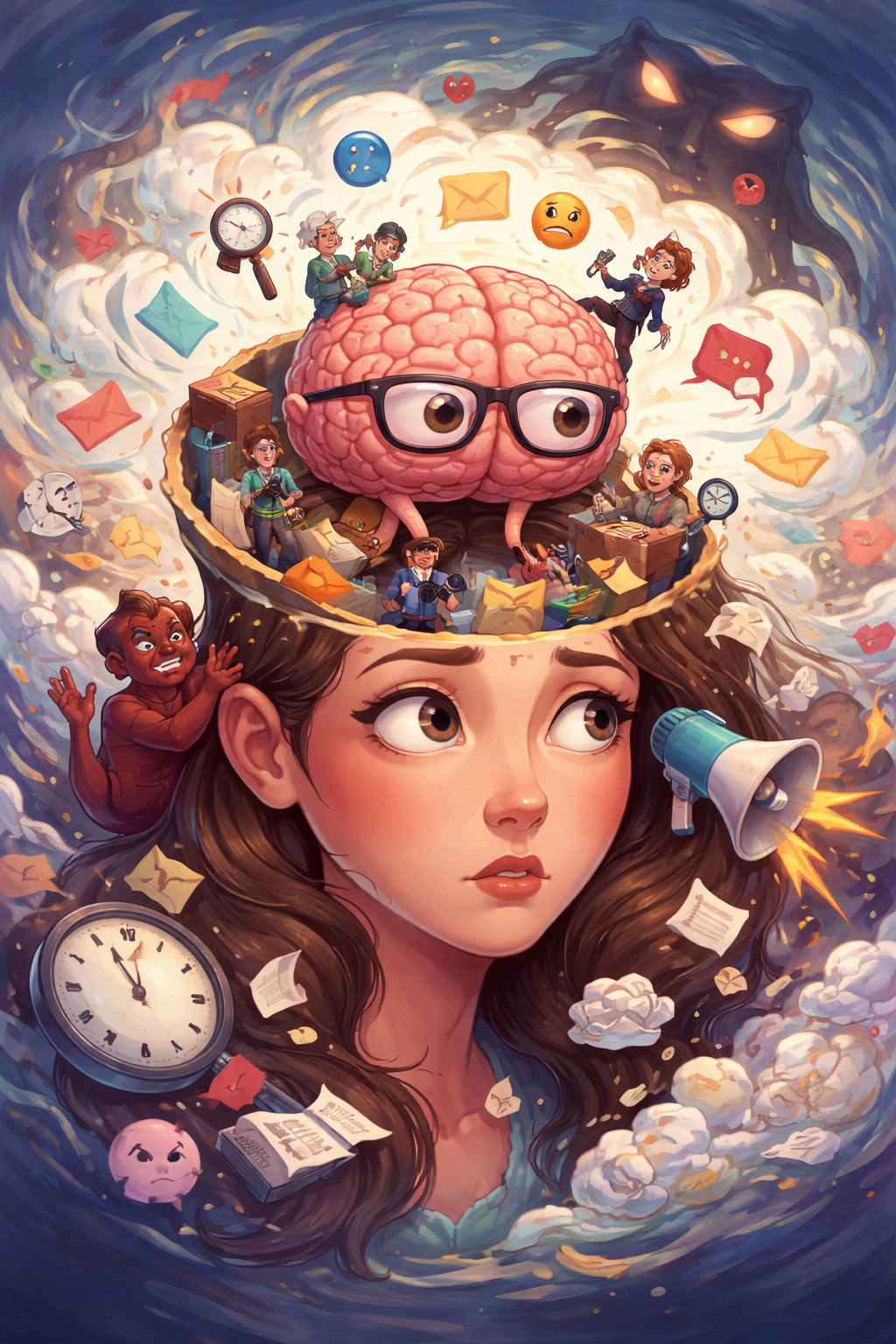
You would expect your brain, your constant companion, decision-maker, and internal storyteller, to be looking out for your best interests. To be fair, it makes an attempt. However, it has developed several negative behaviors, such as distorting reality, bypassing information, and making you feel like the problem.
In other words, your brain is a gaslighter.
Not in a malevolent, villain-twirling-mustache manner. More like a well-meaning but completely untrustworthy friend who claims, “No, you definitely locked the door,” just before you spend 20 minutes spiraling in the parking lot.
The strange thing is that the majority of these mental tricks are the result of mechanisms designed to help you live, make quick decisions, and stay safe. Your brain employs shortcuts to stay efficient as it constantly filters massive volumes of information. What is the issue? These shortcuts prioritize speed and emotional impact above accuracy.
That is, your brain would prefer give you a quick, convincing response than a slow, right one. It fills in gaps, makes assumptions, and relies heavily on previous experiences—even if those experiences are no longer relevant. It behaves more like a storyteller than a fully logical computer, occasionally embellishing for dramatic effect.
Let us look at the most typical illusions your brain plays on you—and why you keep believing them.
1. It Rewrites Your Memories Like a Bad Editor
Instead of keeping memories as videotapes, your brain reconstructs them each time you think about them. This indicates that things can change, emotions can be heightened, and sometimes entire events can be creatively altered.
Every time you revisit a memory, you are softly altering it rather than simply recalling it. What you feel “really” happened might be influenced by your current state of mind, beliefs, and even external facts. When those changes aggregate over time, your mental version can veer surprisingly from reality.
Yes, the five-year-old debate in which you clearly won? It is very likely that your brain gave you a small PR bump.
2. It Makes You Think Everyone Is Paying Attention to You
Have you ever felt that all eyes were on you when you tripped, said something awkward, or sent a dangerous text?
That is known as the spotlight effect. Your brain significantly overestimates how much others notice you. In actuality, most people are preoccupied with the possibility of being evaluated.
The explanation for this is simple: you are the focus of your own experience. Your brain has constant access to your ideas, actions, and perceived mistakes, so it assumes they are equally apparent to everyone else.
Meanwhile, everyone else has already gone on, sometimes in seconds. What feels like a landmark moment to you is a minor detail to everyone else.
3. It Confuses Thoughts With Facts
Just because you think something does not mean it is true—try telling your brain that.
Thoughts such as “Everyone thinks I am annoying”• “I am going to mess this up”• “They did not text back because they hate me now” …feels real since your brain projects confidence. There are no citations. No evidence. Just vibes.
Your brain is really good at creating tales, but not so good at fact-checking them in real time. Once a concept occurs, it is frequently considered as significant just because it exists.
The problematic issue is that emotional intensity makes thoughts seem even more real. The stronger the emotion, the more convincing the thought—even if it is utterly unfounded.
4. It Loves Negative Stuff Way More Than Positive
You can receive ten compliments and one somewhat strange look—guess which one your brain focuses on?
That is the negative bias. Your brain is designed to prioritize possible threats over happy experiences. From an evolutionary standpoint, this makes sense: overlooking a threat was considerably more costly than missing a compliment.
However, in modern life, this wiring might feel extremely imbalanced. Positive moments pass swiftly, whereas bad ones linger, replay, and expand.
This might lead to silent overthinking: repeating talks, evaluating tone, and questioning whether you said anything “off.” Your brain simply starts a tab that you did not ask for and refuses to close.
5. It Makes You Fear Things That Aren’t Actually Likely
Your brain is not particularly good at dealing with probability. It has a tendency to overestimate dramatic, alarming situations while underestimating boring, likely ones.
This is because your brain is dependent on vividness. If something is simple to imagine—especially if it is emotional or dramatic—it appears more likely to occur.
So your thinking jumps to: “This is going to go badly”• “I am going to regret this”• “Something is off”
Even when there is little to no evidence, your brain creates the most compelling story.
6. It Tricks You Into Thinking You’re Always Right
Your brain purposefully filters information to confirm your preexisting opinions because it enjoys being correct. We refer to this as confirmation bias.
Once you have accepted a concept, your brain begins quietly gathering information to support it while ignoring everything that contradicts it. Your thoughts become stronger and more “obviously true” over time as a result of this feedback loop, even if they are incorrect or incomplete.
If you believe you are not good at anything, you will be more aware of your mistakes.• When someone dislikes you, even neutral actions can feel suspect.• You are doing great, and everything proves it. Not wrong, but sometimes very dedicated to a perspective.
7. It Makes Time Feel Completely Unreliable
Have you ever noticed how 5 minutes on social media feels like 45 minutes? Similarly, waiting 10 minutes feels like an hour. Growing up, summers seemed interminable, but now time flies.
Attention and emotion have a significant impact on how you see time. Time seems to move faster when you are engaged. When you are bored or uncomfortable, it stretches.
What appears to be a brief instant can quickly become a whole internal TED Talk, particularly when your mind wanders or begins to analyze something in depth.
8. It Turns Uncertainty Into Anxiety
When your brain lacks enough information, it does not simply respond, “Let us wait and see.”
No, it fills in the blanks, typically with worst-case scenarios.• “They have not replied yet…something is wrong.”• “I made a mistake…this is going to be a disaster.”
Once you have an idea, your brain secretly acquires information to support it, rejecting any contradictory data. Even if your thoughts are faulty or incomplete, this feedback loop strengthens and makes them more “obviously true” over time.
9. It Downplays Your Wins (But Highlights Your Flaws in HD)
Did something go well? Your brain says, “That was luck.”
Have you made a mistake? Your brain says, “Let us replay that 47 times tonight.”
Even when you are performing well on a regular basis, this imbalance might make it tough to gain confidence. Achievements are minimized, while weaknesses are exaggerated.
Your brain acts as both a critic and a coach, but not necessarily in a positive way. And, over time, that internal tone might change how you perceive yourself more than any external criticism.
10. It Adapts So Fast That Nothing Feels Good for Long
You finally receive what you wanted—and for a few moment, it feels incredible.
Then your brain says, “Cool.” “What is next?”
This is referred to as hedonic adaptation. Your brain adapts fast to new situations, resetting your baseline so that what was once exciting becomes commonplace.
While this keeps you motivated and moving forward, it can make it difficult to recognize your progress. Wins begin to feel transient, and satisfaction fades.
Why This Matters More Than You Think
These mental habits may appear harmless—or even amusing—but they influence how you live your entire life. The stories your brain tells you affect your confidence, relationships, decisions, and even your willingness to try new things.
When these stories are misinterpreted (or completely incorrect), they might stifle your creativity. Your brain’s perception of reality may lead you to miss opportunities, misinterpret events, or doubt yourself unnecessarily.
The good news is that awareness alters everything. Once you have identified these patterns, you may start questioning them. You do not have to accept every thought just because it appears. You can pause, evaluate it, and decide whether it is truly worth your time.
How to Push Back (Without Fighting Your Brain All Day)
You do not need to “fix” your brain or compel it to stop doing these things; that is unrealistic. Instead, the idea is to create some barrier between you and your thoughts.
Simple tactics include asking, “What is the evidence for this?”• Consider other hypotheses.• Recognize when an idea is emotional yet lacks logic. • View thoughts as recommendations rather than facts.
Even a brief delay can stop the automatic loop and allow you to respond differently.
Final Thought
Your brain is not trying to sabotage you; it is simply running outdated software in a very current world.
It tries to keep you safe, efficient, and one step ahead, but that can lead to overreaction, overanalysis, and, on occasion, startling confidence in making things up.
The idea is not to mute your brain (good luck with that), but to become more aware of when it is being overly dramatic. Because once you perceive the pattern, it becomes much more difficult to truly immerse yourself in it.
So, the next time your brain confidently tells you something dramatic, questionable, or slightly insane, you can pause and think:
“Okay…is this reality, or is this my brain being extra again?”
References
- Kahneman, D. (2011). Thinking, Fast and Slow. Farrar, Straus and Giroux.
- Gilovich, T., Medvec, V. H., & Savitsky, K. (2000). The Spotlight Effect in Social Judgment. Journal of Personality and Social Psychology.
- Loftus, E. F. (2005). Planting misinformation in the human mind. Learning & Memory.
- Baumeister, R. F., et al. (2001). Bad is stronger than good. Review of General Psychology.
- Tversky, A., & Kahneman, D. (1974). Judgment under uncertainty: Heuristics and biases. Science.
- Nickerson, R. S. (1998). Confirmation bias: A ubiquitous phenomenon. Review of General Psychology.
- Droit-Volet, S., & Meck, W. H. (2007). How emotions color our perception of time. Trends in Cognitive Sciences.
- Grupe, D. W., & Nitschke, J. B. (2013). Uncertainty and anticipation in anxiety. Nature Reviews Neuroscience.
- Diener, E., Lucas, R. E., & Scollon, C. N. (2006). Beyond the hedonic treadmill. American Psychologist.